
The short version
Salt marshes across southern New England are losing grass along their creeks, and crabs are part of the story. On Cape Cod, earlier studies blamed the purple marsh crab and linked its rise to overfishing of the fish that eat it. This team surveyed four Rhode Island marshes and dug through two decades of records. They found that fiddler crabs, not purple marsh crabs, dominate there. Crab burrows along creeks have increased sharply, and the increase tracks rising seas and changing bird populations more closely than fishing pressure.
What the researchers did
Kenneth Raposa of the Narragansett Bay National Estuarine Research Reserve led a group of EPA, state and university scientists. They wanted to look at the whole crab community at once, rather than one species at a time, and to weigh several possible causes together.
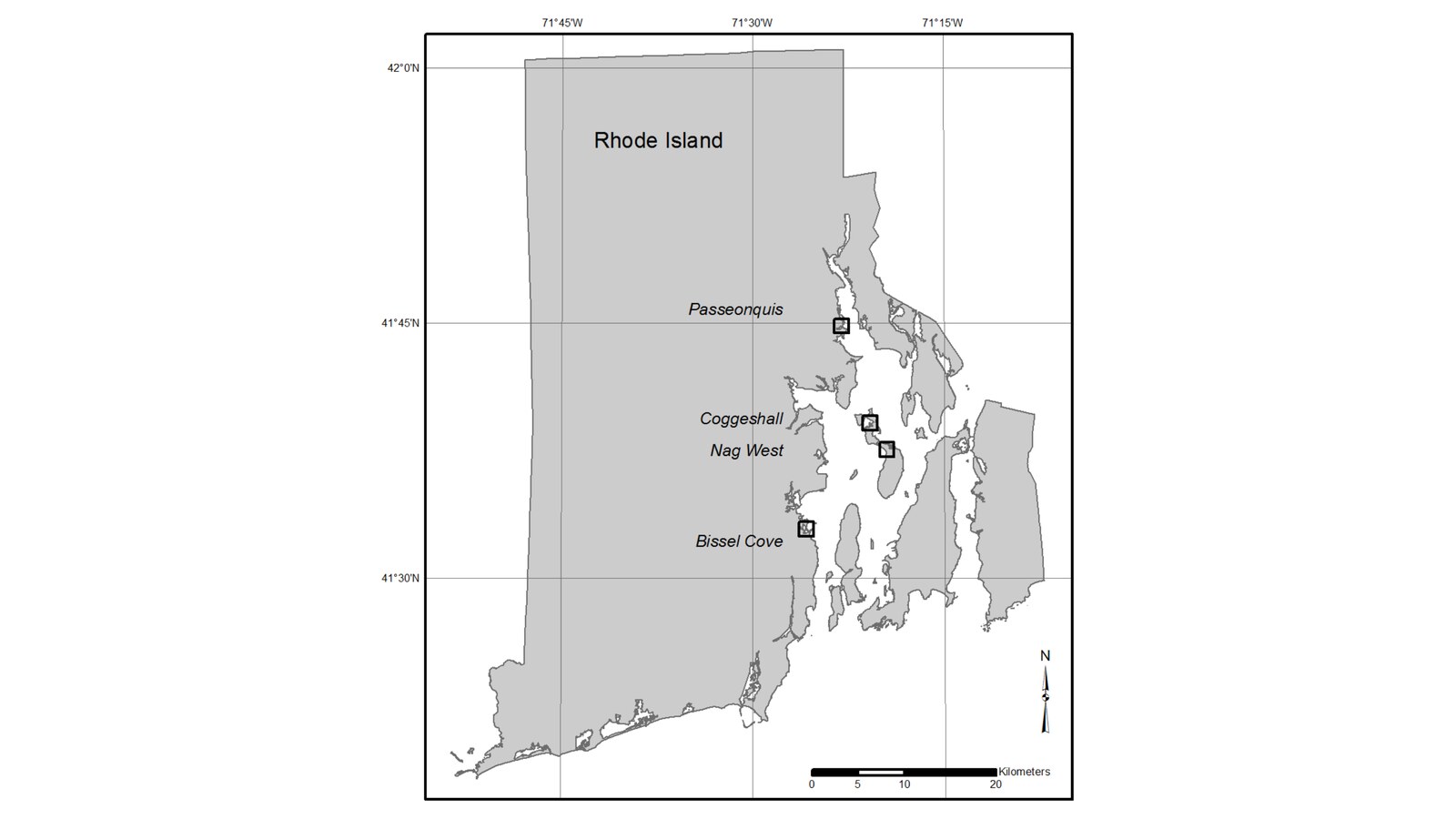
- In 2014 they sampled four Narragansett Bay marshes that range from low and frequently flooded to high and dry. Each marsh had 20 fixed stations spread across bare creekbanks, grassy creekbanks, the marsh platform and the upland edge.
- They caught crabs in pitfall traps, counted and measured burrows, and recorded elevation, plants and soil properties.
- They compared burrow counts from ten reference marshes in 1998 and 2016, and looked at trends in recreational fishing, wading birds, ospreys and high-tide levels.
What they found
- Fiddler crabs rule. Of the crabs caught, 64.5% were fiddler crabs and 29.6% were invasive green crabs. Purple marsh crabs made up only 5.5%.
- Lots of burrows, mostly small. Burrows averaged 42 per square meter and reached 257 in some plots. About 87% were under 2 cm wide, the size made by fiddler crabs.
- Creekbanks are filling up with burrows. Burrow density along creekbanks rose significantly between 1998 and 2016. It did not change significantly on the marsh platform.
- Wetter marsh, more crabs. No crabs were caught at the highest elevations. Going lower and wetter, fiddler crabs appeared first, then purple marsh crabs and green crabs.
- Fishing doesn’t explain it here. Recreational fishing for crab-eating fish such as striped bass fell between 2004 and 2014. Meanwhile, wading birds that eat crabs declined, and average high tides rose.
What it means for Waquoit Bay today
Salt marshes around Waquoit Bay face the same rising seas, and Cape Cod marshes have their own crab problem. This study suggests that as marshes get wetter, crabs will keep spreading. The authors predict crab numbers will keep growing with sea-level rise, at least until inundation thresholds for crab survival are exceeded
(Raposa et al., 2018).
The authors also stress that the causes differ from marsh to marsh, so managers need local data before choosing a fix. They recommend adding crab counts to long-term marsh monitoring programs so changes can be tracked over time. This study covers Rhode Island marshes; Waquoit Bay’s crab species and causes would need local data. For a Cape Cod comparison, see how purple marsh crabs are widening Cape Cod marsh creeks.
Read the paper
Raposa, K. B., McKinney, R. A., Wigand, C., Hollister, J. W., Lovall, C., Szura, K., Gurak, J. A., Jr., McNamee, J., Raithel, C., & Watson, E. B. (2018). Top-down and bottom-up controls on southern New England salt marsh crab populations. PeerJ, 6, e4876. https://doi.org/10.7717/peerj.4876
License: © 2018 Raposa et al. Open access under the Creative Commons Attribution 4.0 (CC BY 4.0) license. The full PDF below is reproduced unmodified from the publisher, PeerJ. Funding came in part from NOAA under the federal Coastal Zone Management Act, and from the US EPA and the Rhode Island Department of Environmental Management. The card image is Figure 1 from the paper (CC BY 4.0).
Drafted with AI assistance from the linked source.


