
The short version
Scientists from the US EPA, the US Geological Survey and Barnstable County’s septic test center worked with the Barnstable Clean Water Coalition to upgrade the septic systems at 14 neighboring homes in Barnstable. Each new system sends wastewater through an air-fed stage and then through a tank of woodchips. Over about two years, most of the systems removed more than 90% of the nitrogen in household wastewater and usually met the state’s new goal of 10 mg/L. One system fell short because the home used more water than it was designed for.
What the researchers did
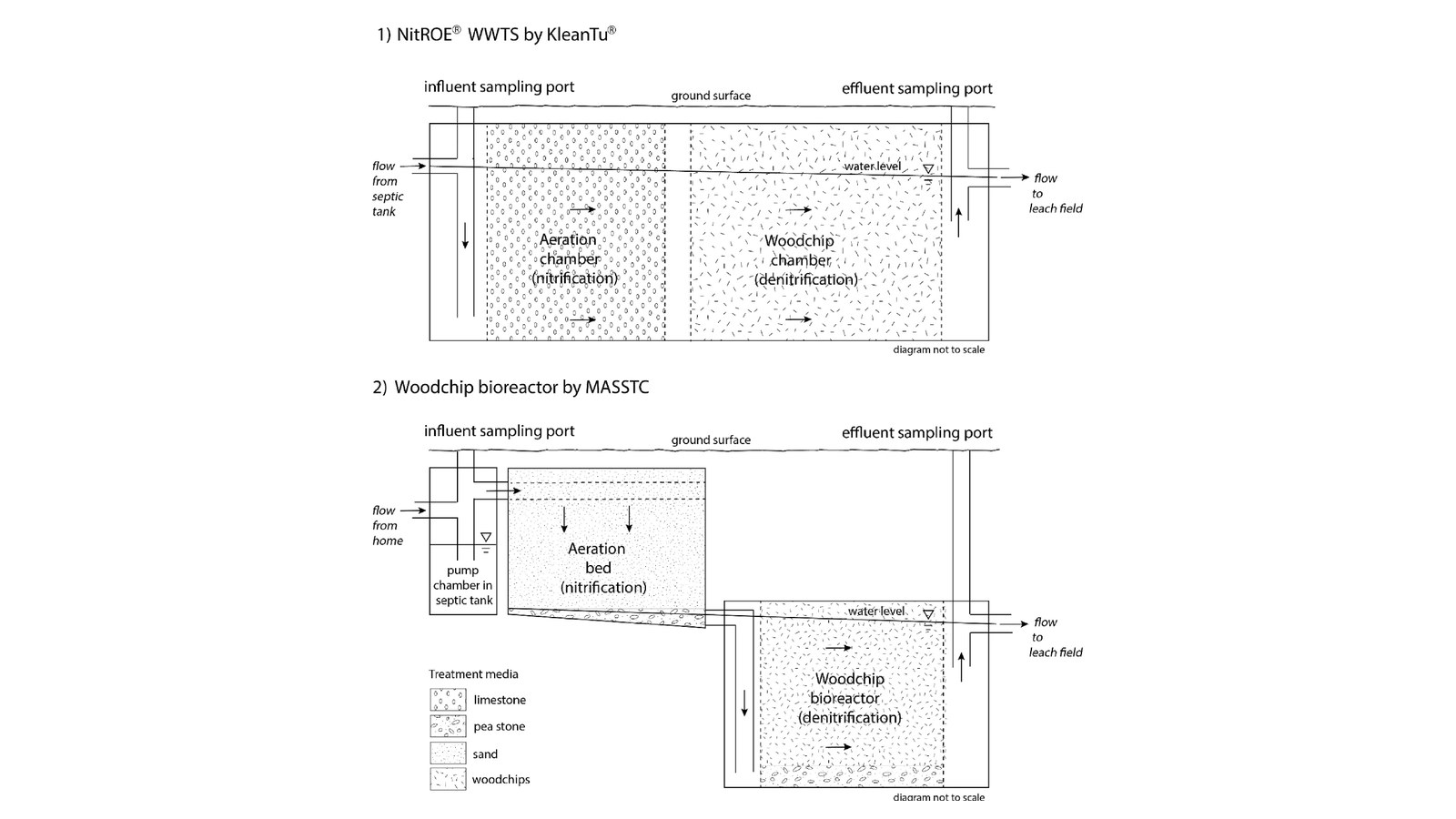
The study took place near Shubael Pond in Barnstable’s Three Bays watershed. That watershed has more than 5,000 septic systems and cesspools and a state cleanup target that calls for a 60% cut in nitrogen. Barnstable is sewering in three phases over 30 years, and the chosen neighborhood was not expected to get a sewer for 20 years or more. Both designs tested work the same basic way. Bacteria in an oxygen-rich stage turn ammonia into nitrate. Then, in a low-oxygen tank of woodchips, other bacteria feed on the wood and turn the nitrate into harmless nitrogen gas.
- Two designs: 13 homes got a NitROE® unit, a commercial concrete tank with an aerated limestone chamber followed by a woodchip chamber. One home got a non-proprietary design from the Massachusetts Alternative Septic System Test Center (MASSTC): a sand bed followed by a 1,500-gallon woodchip box.
- Installation and cost to homeowners: Systems went in between 2021 and 2023. The Barnstable Clean Water Coalition offered residents full subsidies, and a $20,000 grant from EPA’s Southeast New England Program helped pay for the non-proprietary system.
- Monitoring: Wastewater going into and coming out of each nitrogen-removing unit was sampled monthly. Water meters inside the homes recorded flow every hour, so the team could estimate how many kilograms of nitrogen each home sent into the ground. The paper reports 25 months of data for the 13 systems with at least a full year of monitoring.
What they found
- More than 90% of nitrogen removed. In the 12 NitROE® units, nitrogen concentrations fell by an average of 94.9%, with individual systems ranging from 89.9% to 98.5%. A conventional septic system removes 10–40%, according to studies the authors cite.
- Clean enough to meet the new goal. Wastewater entering the systems averaged 97.8 mg/L of nitrogen. Treated effluent from the NitROE® units averaged 7.6 mg/L, below the 10 mg/L goal that Massachusetts set in 2023 for the best available nitrogen-reducing systems.
- Big cuts in the load per home. Using median values, the nitrogen each home sent into the ground dropped from about 15.9 kg a year to 0.72 kg, a 95.5% reduction.
- Mostly reliable, with hiccups. Individual NitROE® units met the 10 mg/L goal in 58.3% to 100% of samples (median 88.2%). Performance dipped when air lines leaked. Four systems did worse in colder months, sometimes topping 40 mg/L, and a few took up to four months to get going after start-up.
- Too much water swamped one system. The non-proprietary system averaged only 20.6% removal. Its household used an average of 390 gallons a day, more than the 330-gallon design, and the sand bed stayed waterlogged. The authors say this result does not show the design’s full potential.
- Some phosphorus removed, too. Although the systems were not designed for it, phosphorus fell by about 30% on average. That is still far too much phosphorus for sensitive freshwater ponds.
What it means for Waquoit Bay today
Septic systems are the biggest controllable source of nitrogen reaching Waquoit Bay (see our explainer on the state’s threshold report). Like Barnstable, Falmouth and Mashpee will not sewer every neighborhood soon, and Falmouth’s draft plan pairs sewer areas with septic nitrogen-reduction areas. This study shows that upgraded septic systems with woodchip tanks can remove more than 90% of nitrogen (N) loads from effluent
(Erban et al., 2024) in real Cape Cod homes. That goes well beyond the sawdust-layer drainfields tested a few years earlier.
The results come with conditions. These homes were mostly lived in year-round, which differs from the seasonal homes common around the bay. The systems need working air pumps, regular inspections and water use that stays within design limits. The authors suggest a “septic utility” or similar management entity to look after many systems at once. MASSTC has started the first such program in Massachusetts, based partly on this project. Any homeowner considering one of these systems should check with the town Board of Health about which designs are approved.
Read the paper
Erban, L. E., Wigginton, S. K., Baumgaertel, B., Horsley, B., McCobb, T. D., Crocker, Z., Horsley, S., & Gleason, T. R. (2024). Reducing wastewater nitrogen loading by >90% with carbon-amended septic systems: A field demonstration in Barnstable (Cape Cod), Massachusetts. Journal of Environmental Management, 370, 122737. https://doi.org/10.1016/j.jenvman.2024.122737
License: Published by Elsevier Ltd. Open access under the Creative Commons Attribution 4.0 (CC BY 4.0) license. The full PDF below is reproduced unmodified from the publisher. The card image is Figure 2 from the paper (CC BY 4.0).
Drafted with AI assistance from the linked source.


