
The short version
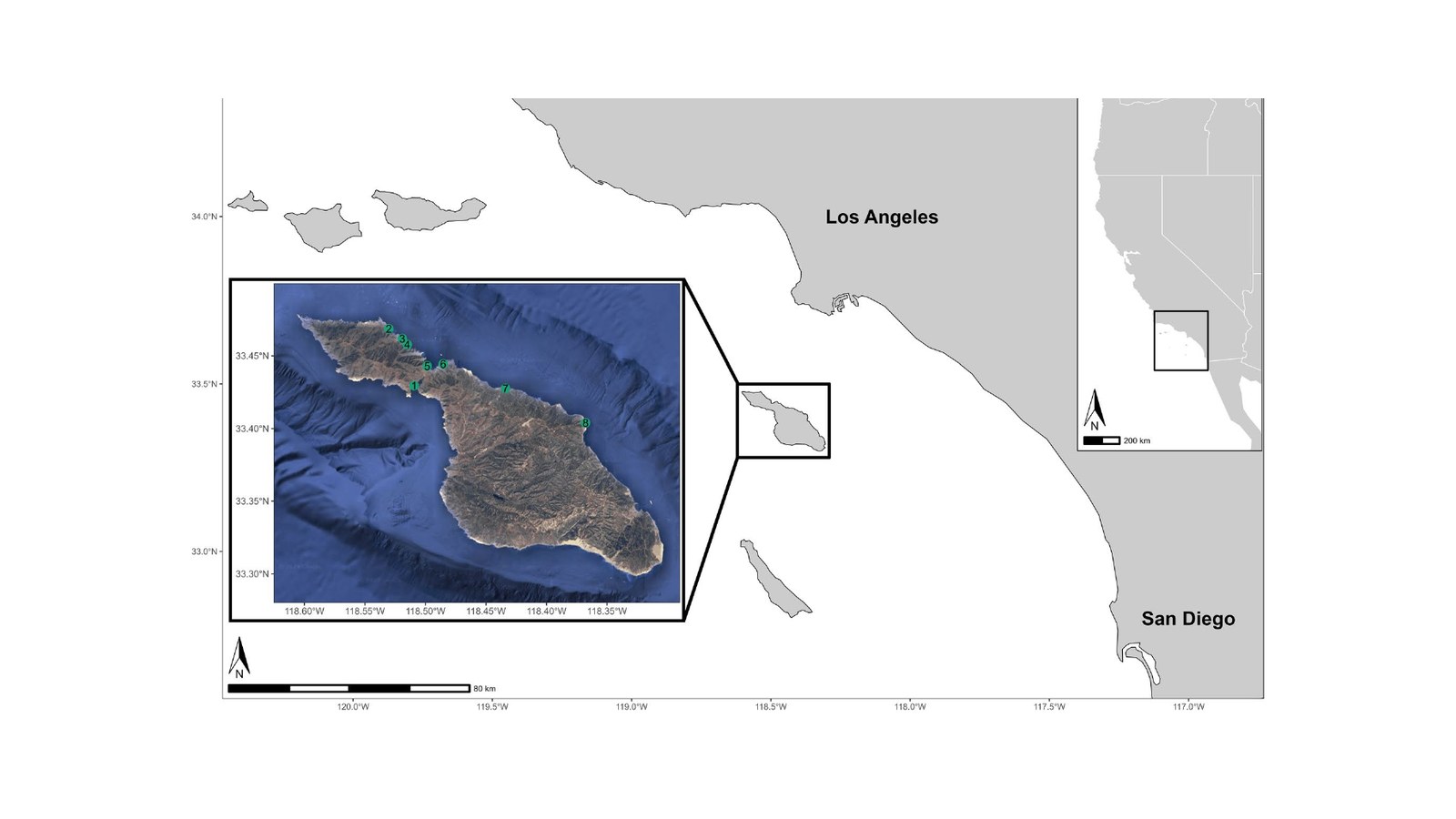
Scientists and volunteer divers moved 8,400 eelgrass shoots from a healthy meadow to a nearby spot where eelgrass had disappeared, off Catalina Island in Southern California. Two years later, the replanted area had grown into a meadow of about 0.18 hectares (roughly 0.45 acre). It had about as many shoots, blades as long, and the same mix of fish as the island’s natural eelgrass beds. The key to success was choosing a site where the water was still good enough for eelgrass to grow.
What the researchers did
Most eelgrass restoration on the US West Coast happens in sheltered bays. This team tried something new: a transplant on an exposed stretch of open coast. The site, called Button Shell, once had a healthy eelgrass bed, but it had been gone since at least 2018. The authors link that loss to a rare, intense hurricane, not to long-term pollution.
- Checking the site first: Before and during planting, sensors at both the donor bed and the transplant site recorded light, dissolved oxygen and water temperature every 10 minutes for 28 days.
- Planting: In June 2022, divers thinned shoots from Ripper’s Cove, a healthy 0.59-hectare bed, and replanted them the same day. Some plots got single shoots held down with small garden stakes. Others got bundles of 10 shoots tied with biodegradable twine and anchored with a wooden stick.
- Monitoring: The team surveyed the new bed quarterly through July 2024 and compared it each year with seven natural beds on the island. Divers counted fish, and an underwater time-lapse camera photographed visitors to the site.
What they found
- The meadow spread. The planted area grew by about 150 square meters in the first year and about 563 square meters by the second. In all, the project created more than 1,580 square meters of new eelgrass habitat within a bed measuring 0.18 hectares.
- High survival. Eight months after planting, single-shoot plots held 116% of the shoots planted, because the plants were already spreading. Bundle plots held 51%. The authors note that other open-coast transplants in the region lost 70–95% of their shoots within six months.
- It caught up with natural beds. Over 2023–2024 the transplant averaged 244 shoots per square meter, compared with 306 in the reference beds. By 2024 its shoot density was not significantly different from the natural beds. Its blades averaged 53.4 cm long, compared with 50.1 cm in the reference beds.
- Fish moved in quickly. Divers recorded 16,760 fish of 33 species across 200 surveys. The fish community at the transplant differed from the natural beds in 2022 but was statistically the same in 2023 and 2024. The camera also photographed an endangered green sea turtle at the site.
What it means for Waquoit Bay today
This is good news for anyone hoping to see eelgrass return to Waquoit Bay: given the right conditions, a replanted meadow can look and work like a natural one within two years. But the lesson is in the conditions. Button Shell lost its eelgrass to a one-time storm, and the team confirmed that light and oxygen were still good before planting. As the authors put it, site selection is one of the most critical steps in seagrass restoration
(Sanders et al., 2025).
Waquoit Bay’s situation is different. Our eelgrass was lost to a chronic problem: nitrogen from the land feeding the algae and seaweed that shade it out (see why Waquoit Bay lost its eelgrass). Planting into that water would likely fail. Once the towns’ wastewater plans bring nitrogen down toward the state’s threshold, careful, well-monitored transplants like this one could help eelgrass come back faster.
Read the paper
Sanders, R. D., Obaza, A. K., Ginsburg, D. W., Carmack, O. C., Grime, B. C., Burdick, H., Ford, T. K., & Leichter, J. J. (2025). Open-Coast Eelgrass (Zostera marina) Transplant Catalyzes Rapid Mirroring of Structure and Function of Extant Eelgrasses. Estuaries and Coasts, 49, 2. https://doi.org/10.1007/s12237-025-01609-x
License: © The Author(s) 2025. Open access under the Creative Commons Attribution 4.0 (CC BY 4.0) license. The full PDF below is reproduced unmodified from the publisher, Springer Nature. The study was funded by the Pacific Marine and Estuarine Fish Habitat Partnership, with additional support from the US EPA. The card image is Figure 1 from the paper (CC BY 4.0).
Drafted with AI assistance from the linked source.


